Gross Motor Unit (GMU): Overview
The Gross Motor Unit (GMU) is a universal 100‑point scale for describing a child’s gross motor ability, anchored at Lie Supine (0 GMU) and Walk Unsupported (100 GMU). The GMU scale is derived from Rasch Measurement Theory, which models the relationship between a child’s ability and the difficulty of gross motor tasks. When a child’s ability matches a task’s difficulty, they have a 0.50 probability of successfully performing that task.
Using task analysis, our research team rated Body Position, Movement, and Support for the tasks of the Gross Motor Function Measure‑66 (Avery et al., 2003). These three components explain 87% of the variance in Rasch‑derived gross motor task difficulty (Seamon et al., 2024). This means that any gross motor task can be located on the developmental continuum by identifying these three components.
Through construct specification equation modeling and scaling, the GMU system places tasks on a universal 100‑point developmental continuum, allowing clinicians and educators to interpret a child’s motor ability relative to foundational milestones.

The GMU Analyzer App
The GMU Analyzer app operationalizes this measurement system into a fast, intuitive clinical and educational tool. Instead of rating all tasks of an instrument, users administer four brief pass/fail tasks directly in the app. The app instantly calculates:
- GMU Measure
- Standard Error (SE)
- A Milestone Chart showing the child’s ability relative to common developmental milestones
- Optional WHO percentile information
The app is designed for occupational therapy, physical therapy, early intervention, and pediatric education settings. All calculations occur on the user’s device; no personal data is collected, stored, or transmitted.
How the GMU Analyzer Works
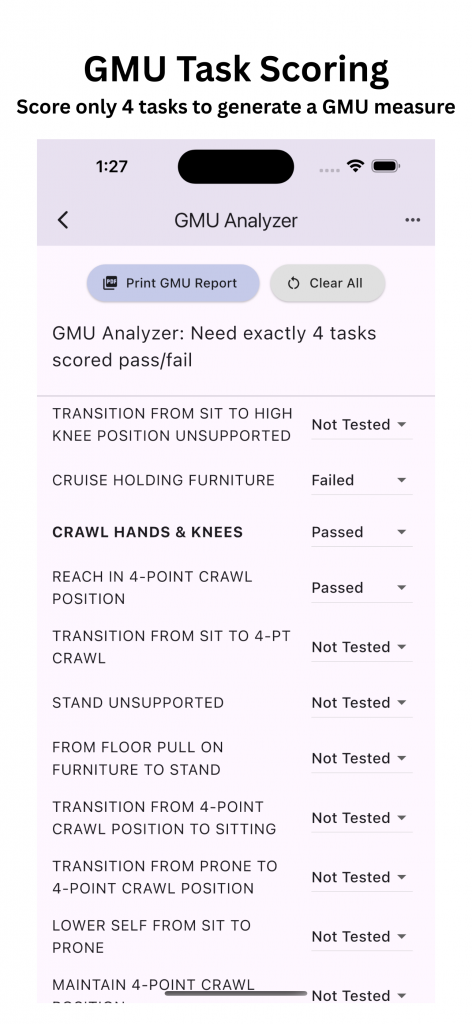
1. Select Tasks Based on the Child’s Ability
The app presents GMU tasks organized along the developmental continuum. Users select tasks that match the child’s observed ability. We recommend administering four tasks near the child’s estimated ability level.
2. Score Each Task (Pass/Fail)
Each task is scored as:
- Pass = 1
- Fail = 0
To generate a valid GMU measure, the child must:
- Pass at least one task
- Fail at least one task
This ensures the app can locate the child’s ability between task difficulties.
3. Instant GMU Measure and Standard Error
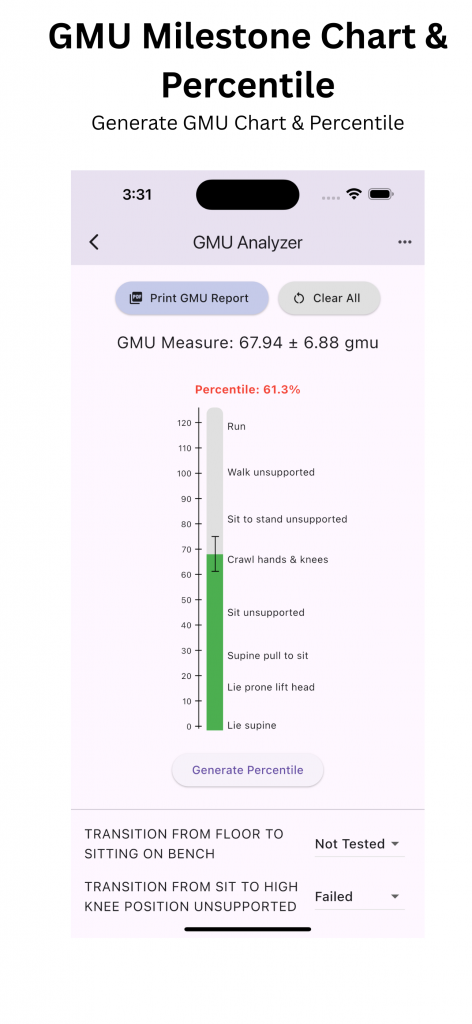
Once tasks are scored, the app automatically calculates:
- The child’s GMU Measure
- The Standard Error (SE)
- A visual Milestone Chart showing where the child falls relative to key developmental milestones (Supine, Head Control, Sit, Crawl, Walk, Run)
For example, a GMU score of 67.94 indicates the child is:
- 67.94 GMUs above lying supine
- 32.06 GMUs below walking unsupported
The SE provides a confidence range around the child’s ability estimate.
4. Interpretation for Clinicians and Family
The Milestone Chart includes well-known developmental milestone anchors:
- Lie Supine
- Head Control
- Sit
- Crawl
- Walk
- Run
These anchors help clinicians quickly interpret where the child’s GMU score falls along the developmental continuum and easily convey the child’s developmental level to family members.
5. Percentile (optional)
Percentiles reflect the percentage of same-age peers at or below the child’s motor skill level based on World Health Organization (WHO) milestone data (WHO Multicentre Growth Reference Study Group, 2006). Based on available data from WHO, percentiles are only generated for ages 5-17 months and only generated for GMU values between 44.61 – 100.01 gmu.
Feedback and Contact
We welcome feedback from clinicians, faculty, and students using the GMU Analyzer. Please reach out through the Contact section of AbilityMetrics.org.
References
Avery, L. M., Russell, D. J., Raina, P. S., Walter, S. D., & Rosenbaum, P. L. (2003). Rasch analysis of the Gross Motor Function Measure: validating the assumptions of the Rasch model to create an interval-level measure. Arch Phys Med Rehabil, 84(5), 697-705. https://doi.org/S0003999303048962 [pii]
Seamon, B. A., Sears, C. L., Anderson, E., & Velozo, C. A. (2024). Defining a universal measurement unit and scale for gross motor development. Front Rehabil Sci, 5, 1243336. https://doi.org/10.3389/fresc.2024.1243336
Seamon, B. A., Sears, C. L., Anderson, E., & Velozo, C. A. (2024). Validating a universal measurement scale and standardized, reproducible unit for gross motor development. Arch Phys Med Rehabil. https://doi.org/10.1016/j.apmr.2024.12.008
WHO Multicentre Growth Reference Study Group. (2006). WHO Motor Development Study: Windows of achievement for six gross motor development milestones. Acta Paediatr Suppl 450: 86-95.